

PenCom’s PPP, Foreign Currency Guidelines Will Boost Pension Coverage … Stanbic IBTC Pension Boss
BY NGOZI ONYEAKUSI
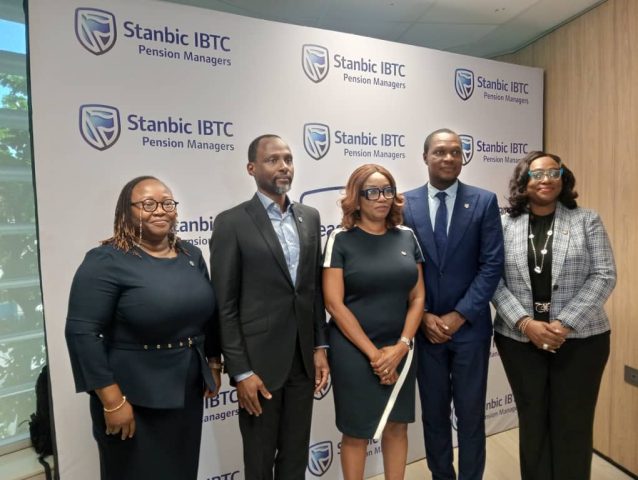
The Chief Executive, Stanbic IBTC Pension Managers Limited, Mr Olumide Oyetan has said that the National Pension Commission (PenCom’s) recently rebranded Personal Pension Plan (PPP) and the new Foreign Currency Pension Contributions (FCPC) Guidelines will boost pension coverage in the country.
Speaking at a media parley in Lagos, aimed at creating awareness on recently introduced reforms by the Commission, under its Pension Revolution 2.0 launch, Oyetan said the move would deepen inclusion, increase flexibility and make retirement planning more accessible to all Nigerians.
According to him, “As you may know, the National Pension Commission has recently introduced two key frameworks, the Personal Pension Plan and the Foreign Currency Pension Contributions, both aimed at deepening inclusion, increasing flexibility and making retirement planning more accessible to every Nigerian.
And there was also some industry forum with the regulator on how to scale this industry. Our aspirations are that in the next four or five years, we will have a lot more Nigerians participating, and attention will then be seen as a force for good and also just help catalyse the various things that will just help Nigerians live a better life,” Oyetan said.
Also speaking at the event, Executive Director, Business Development Directorate, Nike Bajomo, said that Stanbic IBTC Pension Managers had played a significant role in the micro pension space and was set to sustain it.
“We have invested in a micro pension and have 51 per cent of the contributions that we’ve had industry-wide. So, we are one PFA that has invested in that space. Indeed, it’s very, extremely expensive, but as you listened to Olumide earlier, we have, in the Nigerian space, about 70 million workers who are 18 and above, and we have hardly got to 11 million throughout the industry. So, we note that space; whoever cracks that is going to make a difference in the industry,” Bajomo asserted.
The Executive Director, Investment, Efe Omoduemuke, described the foreign currency pension plan as a completion of the pension framework in the country, given that it is now robust enough to cater for every class of workers.
He said, “The retirement savings investment plan cannot be complete without this framework; it’s like saying, ‘You walk into a supermarket or an open market, and they tell you, you can only buy from stores on the right, and you can’t go to the left. Before this framework, we were highly restrictive, and we could not take full advantage of investment opportunities that are out there.”
Throwing light on how contributors can access their funds under the new regulations, the ED, Operations, Lara Osunsoko, said, “If you put money somewhere, you ask, is it going to grow, and then how do I withdraw part of it? So yes, contributors can access up to 60 per cent of the accumulated contributions after a minimum period of six months. So, if you remember, for a personal pension plan, it’s three months, but this is an accumulated contribution for six months, and then withdrawals are allowed twice a year. And then at retirement, which is 50 upwards, you can then elect either to collect your benefit in dollars or to collect it in naira. So, two options: an accumulated contribution minimum of six months and withdrawal twice a year on the contingent portion.”
Head of Compliance, Stanbic IBTC Pension Managers, Edidiong Akan, providing a rundown of the new reforms, noted that with the new investment guidelines, the sector would be able to support the infrastructural drive of the nation.
“You would have noticed the emphasis on the need to build infrastructure. We need to put funds into infrastructure, and a lot of people are saying the pension funds can help with the infrastructure push and all of that. As a regulator looking at that and other things within the industry, the National Pension Commission released this guideline and tweaked the allocation to different asset classes, which would allow operators to do more in those areas and put up more funds towards infrastructure and other pivotal investment areas, but would be a little bit restricted within the industry. They also introduced security lending and repurchase transactions into the industry,” Akan said.
SUPERNEWS Nigeria recalls that the recent PenCom’s Guidelines on the Personal Pension Plan (PPP) was put in place to provide a consistent framework of rules, standards, and procedures to guide Licensed Pension Fund Operators (LPFOs) in the effective implementation of the PPP. The Guidelines also set the strategic direction for expanding pension coverage to self-employed individuals, informal sector workers, and persons exempted by the Pension Reform Act (PRA), 2014. They outline the procedures for participant onboarding, specify the methods and frequency of pension contribution remittances, and detail
withdrawal processes.
Equally Guidelines on Foreign Currency Pension Contributions, published by PenCom, made provision for a wide category of contributors, including Nigerians living and working abroad and Nigerians and foreigners employed in Nigeria by foreign companies or international organisations who are paid partly or wholly in foreign currency.





Leave a Reply