

Countries Must Consolidate Fiscal Positions As Debt Costs Rise, IMF Warns
BY NGOZI ONYEAKUSI
The International Monetary Fund (IMF) has urged countries to strengthen their fiscal positions and reduce debt vulnerabilities before rising borrowing costs and future economic shocks further constrain government finances.
Director of the IMF’s Fiscal Affairs Department, Rodrigo Valdés, said countries must act urgently to create fiscal space through stronger debt management, credible fiscal plans, improved revenue mobilisation and more efficient public spending.
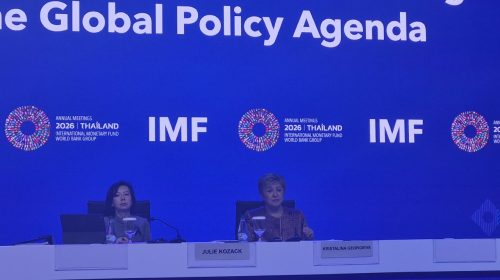
Valdés spoke during a press briefing at the IMF and World Bank Annual Meetings in Thailand, where he warned that emerging market economies with high debt levels, substantial refinancing needs and limited fiscal space were particularly vulnerable to changing financial conditions.
He said countries that still had room to manoeuvre and enjoyed favourable market conditions should take advantage of the opportunity to strengthen their finances before another shock occurs.
According to him, improved fiscal management would help countries reduce vulnerabilities while protecting investments and essential social spending.
Valdés stressed that the urgency of fiscal consolidation had increased because borrowing costs were higher than in previous years, making it more difficult for governments to sustain large debt burdens.
He said, “The more you wait, the more risks that we are in a tipping point,” adding that countries needed to consolidate their finances before financial markets forced them to do so.
The IMF official acknowledged that fiscal consolidation was often difficult, particularly for finance ministers who must convince legislators and citizens of the need for difficult policy decisions.
However, he maintained that the process was achievable, noting that several countries had successfully implemented fiscal adjustments in the past.
He explained that the IMF was working closely with national authorities through Article IV consultations and other policy engagements to communicate the importance of timely action and help governments build support for reforms.
Valdés said the Fund had strengthened its message on the urgency of fiscal consolidation because higher borrowing costs had become a reality, increasing the risks associated with delaying reforms.
Also speaking, another IMF official highlighted the growing burden of debt-service costs, noting that rising interest payments were reducing the resources available to governments for other priorities.
The official said governments faced difficult trade-offs as they sought to meet spending needs in areas such as defence, climate action and other public services while servicing their debts.
On taxation, Valdés said governments should consider a combination of corporate, inheritance and capital gains taxes rather than relying exclusively on wealth taxes.
He explained that capital gains taxation was important for closing loopholes that could otherwise limit revenue collection across corporate and personal income tax systems.
However, he noted that the treatment of unrealised capital gains remained a complex technical issue requiring further consideration.
On fuel subsidies, Valdés warned that the policy was expensive and often benefited higher-income households disproportionately, making it a relatively inefficient way to protect vulnerable populations from rising fuel prices.
He said fully absorbing the impact of a fuel-price shock through subsidies had cost a typical country between one and 1.5 per cent of gross domestic product (GDP) this year.
According to him, governments with sufficient fiscal space should instead deploy targeted social safety nets and use household data to identify those most in need of assistance.
He also suggested targeted interventions, including support for transportation costs, as alternatives to broad fuel subsidies.
Valdés said the IMF had observed some improvement in countries’ responses to fuel-price shocks compared with a few months earlier and the 2022 energy crisis.
Nevertheless, he maintained that fuel subsidies were not the Fund’s recommended approach, warning that they prevented demand from adjusting at a time when global fuel supplies were under pressure.
He emphasised that targeted assistance would enable governments to protect vulnerable households without placing excessive pressure on public finances.




Leave a Reply