

IMF Warns Global Economic Resilience Nearing Limits As Growth Slow
BY NGOZI ONYEAKUSI
The International Monetary Fund (IMF) has warned that global economic resilience is approaching its limits, citing rising energy prices, mounting public debt, higher borrowing costs and vulnerabilities associated with the artificial intelligence (AI) boom.
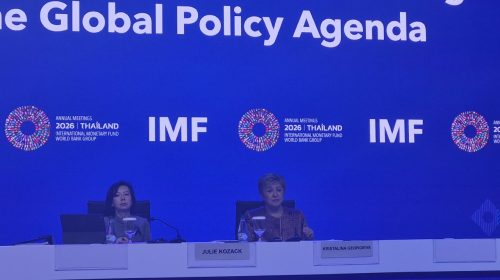
Silvana Tenreyro, Economic Counsellor and Director of the IMF’s Research Department, gave the warning during the presentation of the World Economic Outlook (WEO), at the ongoing 2026 annual meeting of the IMF/World Bank Group holding in Bangkok, Thailand.
According to her, prolonged disruptions to energy supplies and financial market uncertainties could further weaken global growth and fuel inflation.
She said global headline inflation is projected to rise to 4.7 per cent in 2026 before declining to 4.1 per cent in 2027, while core inflation is expected to stand at 3.9 per cent and 3.7 per cent in the two years, respectively.
The global economy, according to her is being shaped by two opposing forces: rising energy and commodity prices triggered by the war, which constrain economic activity, and the technology boom, largely driven by AI, which is boosting demand, investment and trade.
While the two forces affect economic activity differently, she said both are exerting upward pressure on inflation.
Tenreyro explained that the economic outlook varies significantly across countries, depending on their exposure to commodity prices, participation in AI-related activities and borrowing costs.
She noted that energy-exporting countries outside the conflict region and economies closely integrated into the AI cycle are expected to perform better, while energy-importing countries and those with limited participation in the technology boom face weaker growth prospects.
She added that many low-income countries and fragile states are particularly vulnerable to these challenges.
The IMF official identified three major risks threatening the global economic outlook: prolonged disruptions to energy supplies, excessive concentration in AI-related investment and trade, and mounting fiscal pressures arising from higher borrowing costs.
On energy markets, she said renewed tensions in the Middle East had driven up prices of crude oil, gas and refined petroleum products, including diesel and jet fuel.
She warned that a prolonged disruption to production and transportation in the region could trigger further increases in energy and commodity prices.
However, she noted that the global economy had so far benefited from adjustments such as rerouting energy supplies, increased production in other countries, inventory drawdowns, substitution towards alternative energy sources and improved energy efficiency.
Without these adjustments, she said, global growth this year would have been 2.5 per cent instead of the projected 3.1 per cent.
Tenreyro cautioned, however, that some of these protective measures, particularly inventory drawdowns and energy-efficiency gains, were approaching their limits.
She also warned that extreme weather events associated with El Niño could disrupt commodity markets further and intensify supply pressures.
On artificial intelligence, she said the technology-driven boom had become a significant contributor to global growth through investment and trade, but warned that the concentration of AI supply chains in a few countries, sectors and companies posed potential vulnerabilities.
A correction in AI-related market valuations or cybersecurity threats could weaken economic growth and create risks to financial stability, she added.
Addressing fiscal concerns, Tenreyro said rising borrowing costs and interest payments could crowd out essential public spending and reduce governments’ capacity to respond to future economic shocks.
She warned that a combination of higher commodity prices and concerns about public finances could raise borrowing risks, increase inflation expectations and push down growth across advanced and emerging economies.
Under the IMF’s risk scenario, growth in advanced and emerging market economies could be 0.5 to 0.6 percentage points lower by 2027 than under the baseline forecast, while inflation would be materially higher.
To address the risks, she called for restrained fiscal policies, urging countries with high debt and deficits to begin fiscal consolidation and ensure that their deficits and debt levels follow a downward path.
She said any support measures introduced to protect vulnerable households should be temporary and targeted, while preserving price signals.
Tenreyro also urged central banks to maintain a strong focus on price stability, with monetary policy sufficiently restrictive to prevent second-round inflationary effects and return inflation to target.
She stressed that the appropriate monetary policy response would depend on prevailing inflation levels, labour market conditions and countries’ exposure to technology and commodity-price shocks.
The IMF official further emphasised the importance of central bank independence in achieving inflation targets.
She called on governments to rebuild fiscal buffers, safeguard financial stability, encourage private-sector dynamism and strengthen supply-side resilience to support sustainable medium-term growth.
“The economy has been resilient, but that resilience is reaching its limits,” she said, stressing the need for countries to move from coping with economic shocks to rebuilding their capacity to withstand future disruptions.




Leave a Reply